Tiếng Việt
 English
 简体中文
简体中文

Demand for office space for rent is becoming increasingly diverse, requiring businesses to consider office types that suit their size and operational needs. Among the popular options, serviced offices and coworking spaces offer distinct features. This article compares their advantages, disadvantages, and costs to help businesses choose the right solution.
1. Serviced offices: A ready-to-use office solution
A serviced office is a private workspace equipped with furniture, equipment, and operational amenities. Businesses can start working as soon as their staff move in, with a fixed monthly rental cost.
1.1 Who are serviced offices suitable for?
Serviced offices are an optimal workspace solution for organizations and businesses seeking privacy, professionalism, and operational stability:
- Businesses that need private spaces for work and internal meetings.
- Small and medium-sized enterprises with approximately 5–30 employees.
- Companies that frequently welcome clients and partners and require a professional image.
- Newly established foreign companies, branches, or representative offices.
- Businesses that need a business registration address in a reputable office building.

1.2 Advantages of serviced offices
Serviced offices offer several benefits that help businesses free up management resources and focus on their core business activities:
- Privacy: Enclosed, lockable offices that make it easier to protect confidential documents.
- Lower upfront costs: No need to invest in furniture, construction, or infrastructure installation.
- Enhanced professional image: Often includes reception services, meeting rooms, and client reception areas.
- Easier cost control: Many amenities, such as internet, cleaning, electricity, and water, are included in the rental fee.
- Flexible sizing: Businesses can choose a suitable office size and lease term.
1.3 Disadvantages of serviced offices
Despite their significant advantages, businesses should also consider several limitations associated with this model:
- Higher rental costs: Usually more expensive than coworking spaces because private offices and additional services are included.
- Limited customization: Existing furniture and layouts restrict changes to match the company’s brand identity.
- Fewer networking opportunities: Private spaces reduce interaction with other businesses.
- Limited cost savings when staffing decreases: Rental fees remain payable under the lease even if the team becomes smaller.
- Dependence on the operator: The user experience is affected by the building’s services, internet connectivity, and maintenance.
2. Coworking spaces: A flexible workspace solution
A coworking space is a shared working environment where multiple individuals and businesses use the same office space and amenities. Tenants can choose flexible seating at a reasonable cost while expanding their professional networks.
2.1 Who are coworking spaces suitable for?
Coworking spaces are ideal for individuals and organizations that prioritize flexibility and creativity while seeking to optimize initial operating costs:
- Freelancers who need a professional workspace.
- Startups and project teams with fewer than 10 people and an uncertain workforce size.
- Businesses looking to save on rental costs and initial office investment.
- Remote teams or businesses that need temporary workspace in a new market.
- Businesses seeking to expand their networks and find potential partners and customers.

2.2 Advantages of coworking spaces
The shared workspace model offers practical benefits that help young businesses preserve financial resources and encourage innovation:
- Flexible rental terms: Spaces can be rented by the hour, day, or month, with the number of seats adjusted as needed.
- Lower upfront costs: No need to invest in furniture, equipment, or office management.
- Dynamic environment: Open spaces and professionals from diverse industries can inspire new ideas.
- Easy networking: Opportunities to connect and collaborate through events and workshops.
- Comprehensive amenities: Internet, meeting rooms, pantries, printers, and phone booths are readily available.
2.3 Disadvantages of coworking spaces
Despite their flexibility, businesses should be aware of several limitations associated with shared workspaces:
- Limited privacy: Shared spaces can make confidential meetings and the handling of sensitive data more difficult.
- Potential distractions: Noise and surrounding activities may affect productivity.
- Limited brand visibility: Opportunities to decorate, display company signage, and customize private spaces are restricted.
- Restrictions on business registration: Not every coworking location supports business registration.
- Higher costs when expanding: Renting multiple seats may become more expensive than renting a private office.
2.4 Hidden costs businesses may incur when renting coworking spaces
The advertised price of a coworking space usually covers only the workspace and basic Wi-Fi. In practice, businesses may incur additional charges for meeting rooms beyond the allocated allowance, printing, parking, and air conditioning outside regular hours. These extra fees can significantly increase the total budget compared with initial estimates.
Hidden costs can also arise from reduced productivity and missed business opportunities. Crowded spaces and noise can cause distractions, while the lack of private rooms increases security risks. Businesses may also miss opportunities to host partners if a suitable meeting room is unavailable.
In addition, per-seat rental costs can rise quickly as the workforce expands, potentially making the total rental cost higher than that of a private office. If a business relocates before the lease expires, it may also face early termination fees and operational disruption costs.

3. Comparing serviced offices and coworking spaces
Both serviced offices and coworking spaces provide ready-to-use workspaces, but they differ in terms of privacy, cost, and flexibility. The following table helps businesses choose an office model that suits their operational needs.
| Criteria | Serviced offices | Coworking spaces |
|---|---|---|
| Workspace | Private, enclosed offices | Shared workspace |
| Suitable team size | Teams of 5–30 employees | Individuals and teams of 1–10 people |
| Privacy and security | High; suitable for confidential meetings | Limited due to shared spaces |
| Cost | Fixed fees charged per office | Packages priced per seat |
| Lease term | Usually monthly or longer-term contracts | Flexible hourly, daily, or monthly options |
| Business registration | Registration support may be available, depending on the provider | Depends on the provider’s policies and services |
| Brand identity | Easier to showcase through private offices and signage | Limited workspace customization |
| Networking | Less interaction with other businesses | Easier to connect with a professional community |
| Amenities and operations | Often includes reception, internet, cleaning, electricity, and water under the package | Shared amenities available; some services incur additional charges |
4. Should you choose a serviced office or a coworking space?
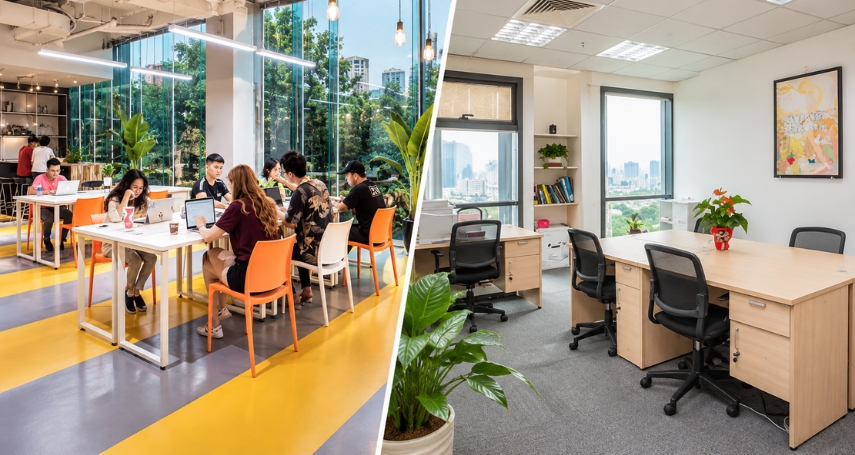
Serviced offices are suitable for businesses with stable operating processes, teams of approximately 5–15 employees, and frequent internal discussions. This model is also worth considering when a company needs a private space to receive clients, build a professional image, or maintain a long-term office.
Coworking spaces are suitable for freelancers, consultants, and small startups with fewer than 5–8 people that do not yet need a permanent workspace. With flexible rental options, low upfront costs, and an open working environment, this model is ideal for testing new markets, carrying out short-term projects, or connecting with other professionals and businesses.
5. Find a suitable workspace with A-Connection
Choosing the right office model helps businesses optimize their budgets, improve operational efficiency, and support long-term development plans. A-Connection provides office rental solutions, helping businesses find workspaces that suit their size and operational needs. Businesses can contact A-Connection for consultation and assistance in finding a suitable office.
- Hotline: 0968 68 80 81
- Website: a-connection.com.vn
- Email: marketing@a-connection.com.vn
Conclusion
Serviced offices and coworking spaces each offer distinct advantages depending on a business’s size, budget, and operational needs. Contact A-Connection today to find a suitable workspace or commercial premises for rent that meets your business requirements.
References: AB Office, Replus
See also: