Tiếng Việt
 English
 简体中文
简体中文

The commercial real estate market is currently experiencing strong growth in shophouses thanks to their flexible combination of business operations and asset accumulation. However, many investors still have concerns about legal issues, actual costs, and the suitability of this property type before deciding to invest. The following article will help you understand what a shophouse is, its identifying characteristics, and the experience you need to invest effectively.
What Is a Shophouse?
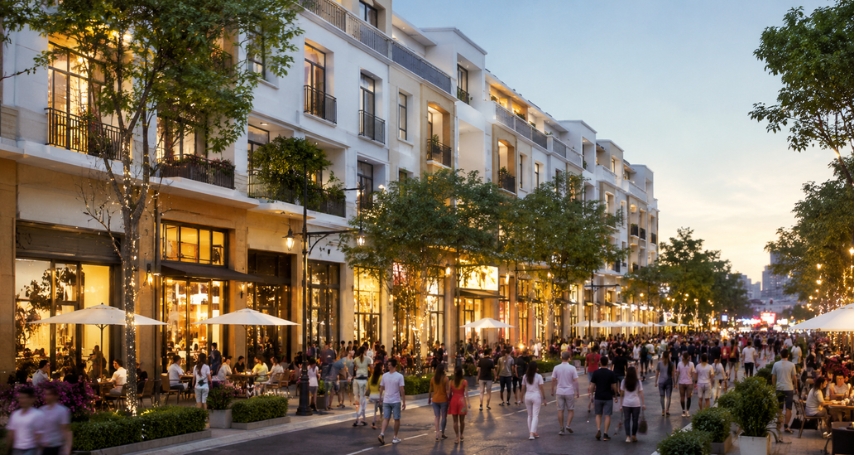
A shophouse, or commercial townhouse, is a real estate model that flexibly combines residential space with commercial business premises. This versatile design meets the family’s living needs on the upper floors while optimizing the open space on the ground floor for a profitable store or office.
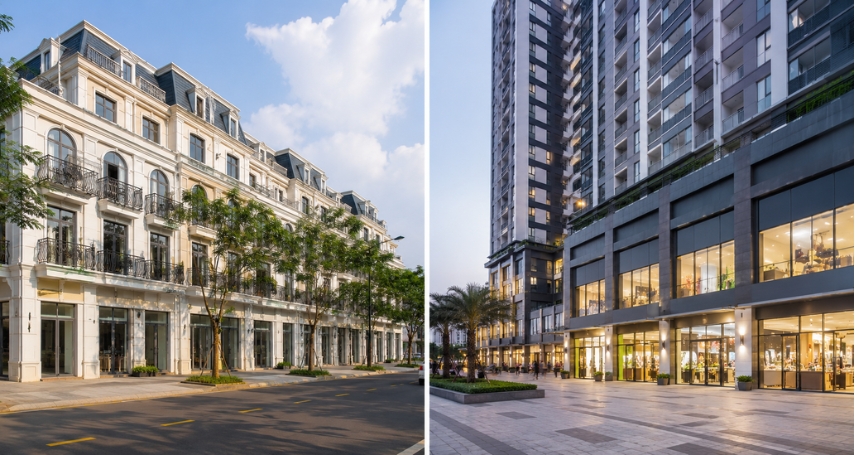
Currently, shophouses are divided into two main types: low-rise shophouses, which are usually located in urban areas or specially planned residential communities, and high-rise shophouses, which are located in the podium of apartment buildings or commercial complexes.
Characteristics of Shophouses
Each type of shophouse has its own design features and intended uses, which directly affect its exploitation potential and investment value. The following sections provide a detailed analysis of each type to help you distinguish between them.
Low-Rise Shophouses
Low-rise shophouses are built along major streets, commercial areas, or comprehensively planned service areas. This type of property provides a bustling business location while creating a modern living space for the owner.
- Planned location: Located directly on major roads, in bustling subdivisions, or at the center of projects with high traffic volumes and strong shopping demand.
- Architectural design: Typically 2 to 5 floors high, with land areas ranging from 85m2 to 250m2, spacious frontages, and floor-to-ceiling glass systems.
- Function: Offers flexible use, with the first floor designated for commercial stores or leasing, while the upper floors serve as a separate living space for the family.
- Ownership legality: Eligible for a Certificate of Land Use Rights and Ownership of Residential Houses with long-term ownership in accordance with the Land Law.
High-Rise Shophouses (Apartment Podiums)
High-rise shophouses are planned on the ground floor and podium floors of high-rise apartment buildings, where residential density is high. These properties are designed to provide commercial services directly to customers from within the development as well as walk-in visitors.
- Planned location: Located in the podium of large apartment buildings, typically distributed from the first to the fifth floor depending on the scale of the project.
- Architectural design: Typically consists of 1 to 2 floors, with areas ranging from 100m2 to 150m2, accompanied by a modern glass frontage.
- Function: Only permitted for commercial services, offices, or convenience stores and cannot be used for residential purposes.
- Ownership legality: Ownership is limited to 50 years according to the project’s lifespan, and temporary or permanent residence registration is not supported.
Distinguishing Shophouses from Townhouses
Although they share many similarities in appearance, shophouses and townhouses differ in several important aspects as follows.
- Purpose of use: Shophouses are designed to combine business and residential use, while townhouses are optimized primarily for quiet residential living.
- Planned location: Shophouses are located on major roads with high pedestrian traffic, while townhouses are often set deeper within internal residential subdivisions.
- Investment cost: Shophouses are at least 20% more expensive than townhouses of the same area due to their advantage in generating greater cash flow.
- Design structure: Shophouses feature spacious, open frontages for displaying goods, while townhouses prioritize maximum comfort for family living.
- Liquidity: Shophouses generally offer better liquidity and commercial appreciation potential than townhouses due to their stable rental potential.
Should You Invest in a Shophouse?
Investing in a commercial townhouse requires buyers to carefully evaluate the balance between cash flow advantages and associated risks. Analyzing the advantages and disadvantages, fully estimating actual operating costs beyond the purchase price, and clearly determining whether the property suits your needs will help optimize the efficiency of your capital.
Advantages and Disadvantages of Investing in a Shophouse
Before making an investment decision, carefully considering the advantages and limitations of shophouses will help investors gain an objective perspective and make an appropriate choice.
Advantages:
- Prime location: Shophouses are often planned along major roads, near the centers of bustling urban areas or resorts, making it easy to access potential customers.
- Smart, multifunctional design: The multi-level design separates the business space on the ground floor from the family’s living space above, maximizing functionality and reducing the cost of renting a separate business premises.
- Scarcity and good liquidity: Shophouses account for only about 2-5% of the total units in a project, creating scarcity that helps limit the risk of depreciation while also providing a typical rental yield of 8-12% per year.

Disadvantages:
- High initial investment cost: The selling price is typically at least 20% higher than apartments or townhouses of the same area, and can even be twice as high in some projects.
- Limited ownership period: For podium shophouses or project land, ownership rights typically last only 50 years, creating concerns among buyers seeking long-term asset accumulation.
- Dependence on the residential community: Business performance and actual profits depend heavily on the rate at which the residential community becomes occupied and the developer’s progress in handing over the premises.
Actual Costs of Owning a Shophouse Beyond the Purchase Price
In addition to the initial purchase price, investors need to calculate additional expenses incurred throughout the ownership and operation of the shophouse.
- Monthly management and service fees, especially for apartment podium shophouses
- Personal income tax, registration fees, and transfer-related costs when buying or selling
- Renovation and fit-out costs to adapt the premises to the intended business purpose
- Opportunity costs incurred while the premises remain unused or vacant
For example, an investor purchasing a low-rise shophouse to open a convenience store will need to pay additional costs for renovating the premises, installing display shelving, and setting up goods storage equipment. In addition, monthly operating expenses such as electricity, water, and staff costs should be calculated alongside bank loan payments if financial leverage is used. Fully estimating these costs helps investors more accurately assess the actual payback period instead of relying solely on the initial purchase price.
Who Is a Shophouse Investment Suitable For?
This commercial townhouse model is suitable for investors with strong financial capacity who are looking for an asset accumulation channel with high liquidity and long-term profit potential. At the same time, this property type is also ideal for households or individuals who want to combine long-term residence with running their own business or leasing out the ground floor to generate stable monthly cash flow.
Conversely, this property type is not suitable for buyers with limited capital or those who must rely excessively on large bank loans, as shophouses are very expensive. Customers who simply seek a quiet living space for residential purposes and have no plans to operate a commercial business should prioritize traditional housing types to minimize investment costs.
See also: How to Choose a Rental Space for a Showroom to Increase Brand Awareness
Shophouse Investment Tips to Avoid Losses
To use capital effectively and minimize the risk of losses, investors should consider the following core principles before deciding to proceed with a transaction.
- Assess residential density and actual demand: Business performance directly depends on the number of residents, the volume of walk-in customers, and the customer segment within the project. Investing in areas with sparse populations or projects that have not reached full occupancy will significantly limit opportunities to reach customers.
- Thoroughly verify legal status and transaction methods: Check the project’s or owner’s Certificate of Land Use Rights before signing a deposit or transfer agreement. At the same time, exercise caution with methods such as capital contribution agreements and authorization letters, as they may carry a risk of disputes.
- Balance investment costs against the ownership period: Carefully calculate depreciation and cash flow based on the 50-year ownership period of podium shophouses or project land. Avoid purchasing at a price that is too high compared with the property’s actual value when its usage period is limited.
- Control risks related to construction and handover progress: Operating plans and cash flow turnover are directly affected by the developer’s completion schedule. Therefore, investors should choose reputable developers with strong construction capabilities to ensure stable progress and liquidity.
Shophouse Legal Status and Ownership Period
According to Articles 171 and 172 of the 2024 Land Law, the land-use period of commercial townhouses is specifically determined based on the purpose of land use or the nature of the approved project.
- Long-term use period: Applies to low-rise shophouses built on residential land for which the State recognizes long-term ownership rights.
- 50-year ownership period: Applies to shophouses located on land allocated or leased by the State for investment projects, or units located in the podium of high-rise apartment buildings.
- Extension consideration mechanism: When the land-use period expires, if the owner wishes to continue using the property, the State may consider extending the land-use period, but for no more than 50 years.
- Conditions for transfer transactions: Under Clause 1, Article 45 of the 2024 Land Law and Article 160 of the 2023 Housing Law, the sale of a shophouse is only legal and eligible for transfer once the property has been granted a Certificate of Land Use Rights by the competent authority.
Purchasing through methods such as capital contribution agreements or authorization letters when the project has not yet been granted a land-use certificate carries significant legal risks and may easily lead to future property disputes for buyers. Therefore, investors should prioritize transactions with complete and clear legal documentation to avoid unnecessary risks.
For apartment podium shophouses, this type of property may only be used for commercial and service purposes, and owners are not permitted to register temporary or permanent residence there. This is an important difference compared with low-rise shophouses that investors need to understand before deciding to purchase in order to avoid confusion about the property’s permitted use.

Find a Reputable Shophouse Rental Space at A-Connection
If you are looking for a suitable shophouse space for business or investment, A-Connection provides comprehensive commercial real estate solutions, from consulting on commercial rental spaces, supplying construction materials, and providing construction packages to various other real estate services, helping you feel confident throughout the investment process.
Reasons to contact A-Connection to find a shophouse space:
- More than 12 years of experience in accurately advising on locations and the potential for exploiting commercial premises.
- A technology platform that helps you quickly and transparently access updated information on available premises.
- An extensive network of customers and partners, making it easy to connect with diverse sources of commercial premises.
- A construction and material supply team ready to support the rapid completion of commercial premises.
Conclusion
Shophouses are a potentially valuable real estate type because they combine business needs with asset accumulation. However, investors need to carefully consider legal issues, costs, and suitability before investing. If you are looking for a shophouse space for business, contact the A-Connection hotline for advice on the solution that best suits your needs.
See also: