Tiếng Việt
 English
 简体中文
简体中文

More and more businesses need to find office space, but not everyone knows how to choose a location that both optimizes costs and suits their operating model. Choosing the wrong premises can lead to unexpected expenses or affect work productivity. Learn about the criteria for renting office space for a company to avoid these mistakes.
1. Key criteria for choosing office space
Choosing office space is not simply about finding a place to work. It also affects employee productivity, brand image, and the company’s operating costs. Below are 6 key criteria that businesses should carefully evaluate before deciding to rent.
1.1 Calculate office space based on the number of employees
Office space should be calculated based on the current workforce and future growth plans rather than estimated subjectively. Choosing a space that is too small can make the workplace cramped and affect productivity, while an excessively large space can result in unnecessary monthly rental costs.
Recommended space standards (based on actual usable area – Net):
- Economy standard (3-4 m²/person): Suitable for startups or companies seeking to minimize costs.
- Standard level (5-6 m²/person): The most common standard in Vietnam, providing enough space for employees to work comfortably.
- Premium standard (7-10 m²/person): Suitable for Grade A offices, creative workspaces, or large enterprises.
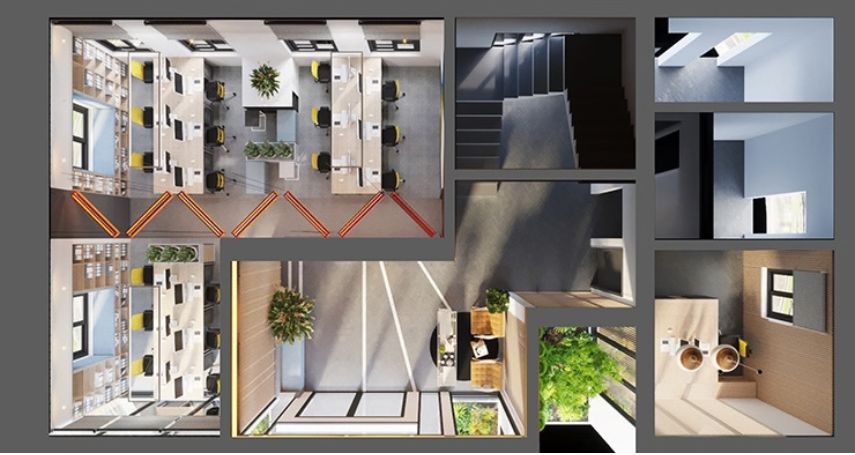
In addition to individual workstations, businesses should allocate additional space for meeting rooms, pantries, storage areas, and shared equipment such as printers and photocopiers. It is also advisable to reserve an additional 10-20% of space based on the expected workforce growth over the next 1-3 years. This helps avoid the costs of relocating too soon and disruptions to business operations.
For a company with a workforce of 20 people applying the standard of 5-6 m²/person, the minimum required rental area would be approximately 100-120 m², excluding additional space reserved for future expansion.
1.2 Choose a convenient location
An optimal office location should balance three factors: being convenient for most employees to commute to work, being located in an area that matches the company’s brand positioning, and being easily accessible to customers and business partners who visit in person.
Another office selection criterion is to avoid areas that are frequently affected by severe flooding or located in low-lying areas below the surrounding roads. Such conditions can not only disrupt operations during the rainy season but also affect the lifespan of office equipment and furniture in the long term.
1.3 Choose an office type that fits your needs
Each type of office space is suitable for a different stage of business development and operating model. Businesses should carefully consider the advantages and disadvantages before making a choice:
- Traditional office (Grade A/B/C buildings): Establishes a reputable and professional image and provides a high level of privacy and security. However, the initial investment costs are high, and strict working-hour regulations may result in additional fees when operating outside regular hours.
- Serviced office / Coworking Space: Helps reduce initial investment costs, comes with ready-made furniture, and offers flexibility in adjusting the workspace size. However, the long-term cost per person can be relatively high, and it may be difficult to establish a distinct company culture.
- Entire townhouse / Officetel: Suitable for businesses that frequently require overtime (OT) and need greater control over operating hours. However, the company must manage security, cleaning, and fire prevention and fighting systems itself.
1.4 Infrastructure and surrounding amenities
The infrastructure and amenities surrounding the premises directly affect employees’ daily working experience as well as the company’s image when welcoming customers and business partners. Businesses should carefully check the following factors before deciding to rent:
- Parking: There should be enough parking spaces for employees and visitors to avoid having to park far away or pay high parking fees.
- Technical infrastructure: A stable power supply, high-speed internet connection, and reliable elevators if the office is located on a high floor.
- Nearby amenities: Restaurants, food outlets, and convenience stores within a 200-meter radius can be an advantage, especially if the company does not provide lunch for employees.
- Nearby banks, post offices, and government offices: Convenient for transactions and administrative procedures that may arise regularly.

1.5 Fully estimate rental and operating costs
In addition to the basic rental price per square meter, businesses should budget for the following cost groups to avoid exceeding the initially planned budget:
- Recurring fixed costs: Including basic rent, management and service fees, and VAT (10%). These should be accurately calculated to determine the actual total monthly cost.
- Variable operating costs: Electricity consumption (charged at either commercial or government-regulated rates depending on the building), parking fees if the allocated quota is exceeded, air-conditioning costs, or fees for working outside regular hours.
- One-time costs: Design and interior construction costs if renting an unfinished space, the security deposit (usually equivalent to 3 months’ rent), and the cost of restoring the premises to their original condition at the end of the lease.
Calculating all these expenses from the beginning helps businesses manage cash flow proactively and avoid unexpected costs after moving into the premises.
1.6 Check legal status before signing the lease
First, businesses need to verify the legal status of the premises through the property ownership certificate or relevant ownership documents, while also checking whether the premises are legally approved for commercial or office use. Avoid renting a regular residential apartment for office use because this type of property may not meet the requirements for registering a company’s tax headquarters.
If the premises are subleased from a third party rather than the original owner, the tenant must request written consent from the original owner allowing the sublease. This helps avoid the risk of an invalid contract or disputes between the parties later.
Finally, businesses should clearly define key terms in the lease, such as the annual rent increase range (typically no more than 5-10% every 2 years), conditions for security deposit refunds in cases of force majeure, and clearly defined responsibilities for infrastructure repairs when major damage or malfunctions occur between the tenant and landlord.

2. Tips for surveying office space before renting
Before paying a deposit and signing a lease, businesses should conduct a thorough on-site inspection instead of relying solely on photos or information provided by brokers, as many technical issues can only be identified through an actual inspection. Below are some key points to check:
- Electricity, water, and air-conditioning systems: Check whether the electrical capacity is sufficient for office equipment, the condition of water pipes, and the operating performance of any existing air-conditioning systems.
- Quality of furniture, flooring, ceilings, and walls: Check for signs of mold, cracked walls, uneven flooring, or water leakage from the ceiling, especially in townhouses or older buildings.
- Noise and area security: Visit the premises at different times of the day, including peak hours, to properly assess noise levels and the surrounding security situation.
- Elevator and fire prevention and fighting systems: Check whether the elevator operates reliably, especially if the office is on a high floor, and whether fire alarms, fire extinguishers, and emergency exits are adequately provided in accordance with regulations.
- Internet connection and mobile signal: Check connection quality at the actual location to avoid weak signals that could affect daily work.

3. Should you rent an unfinished office or one with completed interiors?
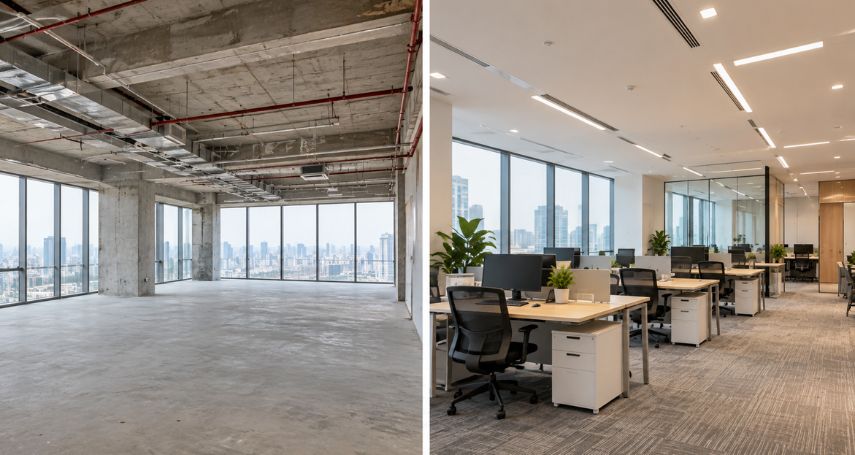
You should choose an unfinished office when the company has a plan to design a space that reflects its own brand identity, has sufficient budget and time for construction from scratch, or plans to rent long-term (from 3-5 years or more) so that the initial interior investment can deliver long-term value. This option is also suitable if the company has specific space-planning requirements that existing furniture and layouts cannot meet.
Conversely, you should choose an office with completed interiors when you need to start operations quickly, do not have much time to wait for construction, or have a limited initial investment budget, such as startups and newly established businesses. This option is also suitable if the company expects to rent for a short term (less than 2-3 years), as the cost of investing in customized interiors may be difficult to recover within such a short period.
4. How to negotiate the rental price for office space
As many landlords today tend to list rental prices above the actual market value to gauge potential tenants’ reactions, understanding how to negotiate can help businesses avoid paying more than necessary:
- Research market prices before negotiating: Check the rental prices of at least 3-5 similar premises in the same area to establish a basis for comparison and avoid being influenced by the landlord’s initial asking price.
- Offer to pay quarterly or annually in advance in exchange for a discount: Landlords are often willing to offer a 5-10% discount if tenants agree to make a larger advance payment instead of paying monthly.
- Negotiate based on the actual condition of the premises: If you identify areas that require repairs or renovation during the inspection, use these issues as a basis for requesting a lower rental price or additional financial support for repairs from the landlord.

5. Find suitable office space at A-Connection
After understanding the criteria that office space should meet, the next step is to find premises that actually fit your company’s operational needs. A-Connection provides commercial real estate solutions, supporting businesses in finding office space for rent as well as turnkey construction and renovation services tailored to business requirements.
With more than 12 years of experience in real estate leasing and construction, A-Connection has an in-depth understanding of the office space market across various areas. This helps businesses save time during the search process and avoid common legal and technical risks when searching for and negotiating premises independently.
Conclusion
Choosing suitable office space requires consideration of multiple criteria, from the area based on the number of employees and convenient location to the office type that matches the operating model, infrastructure and amenities, costs, and clear legal status before signing the lease. If you need support finding office space that suits your preferences, budget, and development plans, contact A-Connection for detailed consultation.
See also: