Tiếng Việt
 English
 简体中文
简体中文

Investing in rental real estate has long been a popular way to generate passive cash flow, thanks to its ability to provide steady returns while increasing asset value over time. However, many new investors fail because they choose the wrong location, miscalculate cash flow, or overlook hidden costs arising during the operation process. Therefore, investors should understand the following rental real estate investment experience before making an investment decision.
1. What is rental real estate?
Rental real estate is an investment model in which owners purchase houses, apartments, rental rooms, or commercial premises and then lease them to others for a certain period. In return, the owner receives rental income on a monthly, quarterly, or otherwise agreed-upon basis.
For example, an investor may purchase an apartment or build a row of rental rooms near a university, then lease them to students and working professionals to generate steady monthly cash flow.

1.1 Benefits of investing in rental real estate
Investing in rental real estate offers investors several significant financial advantages:
- Generating stable passive income: Provides regular rental cash flow on a monthly or quarterly basis, helping investors maintain a consistent source of income.
- Increasing long-term asset value: In addition to rental income, the capital value of the real estate itself also tends to increase over time.
- Leveraging financial leverage: Investors can borrow from banks to purchase an asset and use rental income to repay the loan.
- Protection against inflation: Real estate is a tangible asset that often appreciates alongside inflation, helping preserve the value of the initial investment capital.
1.2 Risks of investing in rental real estate
Alongside its profit potential, investors also need to anticipate the following risks:
- Unstable cash flow due to vacancies: A property may remain vacant for an extended period if tenants cannot be found, significantly reducing revenue.
- Complex tenant management: Tenants may make late payments, damage equipment, or become involved in disputes.
- Maintenance and repair costs: Rental properties generally deteriorate faster than conventional homes, requiring periodic maintenance that can reduce net profits.
- Legal and planning risks: Properties may face issues related to land-use certificates, fail to meet fire prevention and firefighting (PCCC) requirements, or be located in areas subject to clearance or planning restrictions.
2. Valuable experience for rental real estate investment
To optimize cash flow and minimize risks, investors should understand the following practical investment experience.
2.1 Choose a prime location with a dense population
Location plays a decisive role in the success of a rental property. Properties located near city centers, major transportation routes, and essential amenities such as schools, markets, and hospitals generally have strong occupancy potential.
The higher the surrounding population density, the more stable and sustainable rental demand tends to be. Choosing a location in a vibrant market can make the property easier to rent while also supporting price retention and long-term appreciation.
For investors renting a premium spa commercial space in Ho Chi Minh City, central areas or affluent neighborhoods such as District 1, District 3, or Thao Dien should be considered. These locations have a potential customer base with high incomes who are willing to pay for premium healthcare and beauty services.

2.2 Clearly identify the target tenant
Before purchasing a property, investors need to clearly determine who their target tenants will be. This factor directly influences the choice of location, space design, and furnishings, helping maintain a stable occupancy rate over the long term.
For example, if investing in a studio or one- to two-bedroom apartment, the primary tenants are likely to be single professionals or young families who are starting their careers. In contrast, if choosing a property near an industrial park, the target tenants are often foreign experts, who generally have higher expectations for amenities and accompanying services.
2.3 Calculate the return on investment using the 1% rule
The 1% rule is a simple method that helps investors quickly assess the profit potential of a real estate property. Under this rule, the monthly rental income should reach at least 1% of the total investment value of the property.
For example, if an apartment costs VND 1 billion, the monthly rent should be at least VND 10 million. This cash flow helps ensure the ability to cover loan payments, taxes, maintenance costs, and the expected return.
If monthly rental income does not reach the 1% threshold, the property may not generate sufficient returns to cover operating costs. However, investors should also flexibly assess the actual conditions of each market.
2.4 Keep borrowing below 30% of the property value
Using financial leverage through bank loans can help investors optimize cash flow and expand their asset base. Identifying opportunities and using leverage wisely can create the potential for higher returns.
However, experts recommend keeping the loan amount at no more than 30% of the total property value to maintain financial safety. Excessive leverage can turn debt into a financial burden and create significant repayment pressure.

2.5 Invest for the long term and avoid short-term speculation
Rental real estate investment requires investors to hold the property long enough for cash flow and asset value to accumulate, rather than expecting quick profits within a short period.
Reasons to invest in rental real estate for the long term rather than pursue short-term speculation:
- Building stable accumulated cash flow: Rental investment is essentially a way of purchasing future cash flow, providing regular passive income each month rather than relying on quick capital gains.
- Increasing asset value and hedging against inflation: Holding the asset for the long term allows investors to benefit from capital appreciation and preserve asset value amid inflationary fluctuations.
- Avoiding market volatility risks: The current market contains various risks and fluctuations, while short-term speculation can easily result in losses when liquidity breaks down.
2.6 Prioritize residential real estate for first-time investors
First-time investors are often concerned about failure due to limited management experience, cash flow disruption risks, and restricted investment capital. Residential real estate such as apartments or townhouses with moderate values and relatively straightforward legal procedures can help reduce financial pressure.
The residential segment also has strong demand, making it easier to find tenants and manage properties compared with commercial real estate or industrial real estate. This option can reduce concerns about prolonged vacancies and provide greater security for initial cash flow.
2.7 Perform regular maintenance to preserve asset value
Rental properties typically deteriorate faster than conventional homes, requiring owners to carry out regular maintenance and upgrades. Maintaining the property in good condition not only helps attract tenants and maintain rental rates but also enhances the property’s capital value over the long term.
3. How much capital is needed to start investing in rental real estate?
The amount of capital required to invest in rental real estate depends largely on the chosen investment model and property segment. There is no fixed amount that applies to every situation.
With the rent-to-rent model (without owning the property), the initial capital requirement is relatively low, and it is possible to get started with around VND 100 million or less. The investor rents an entire house or commercial space, then renovates it, divides it into rooms, or subdivides the space for subleasing. The investor earns the difference between the original rent and the total rental income collected from individual tenants. This approach is suitable for beginners with limited capital who want to gain experience before making a larger investment.
If choosing the buy-to-rent model, the required capital is considerably higher and varies by segment:
- Rental rooms and boarding houses: Approximately VND 1-3 billion if purchasing land and constructing a new property, or less if using land already owned by the family.
- Apartments: Approximately VND 1.5-3 billion depending on the location. The initial capital requirement can be reduced by taking out a bank loan equivalent to 50-70% of the apartment’s value.
- Entire townhouses for rent: From VND 3-7 billion or more, depending on location, size, and property condition.
- Commercial premises and office space for rent: Typically from VND 5 billion or more, requiring stronger financial capacity and a longer-term investment outlook.

4. Costs often overlooked when investing in rental real estate
In addition to the initial purchase price, investors need to carefully calculate the following “hidden” costs to protect cash flow and avoid the risk of eroding actual profits:
- Legal and administrative costs: Including registration fees, notarization fees, document appraisal fees, and relevant taxes when completing procedures for transferring land and property documents.
- Initial renovation and periodic maintenance costs: Initial repairs required to make the property suitable for rental can account for 5-15% of the property’s value, along with recurring costs for electrical and plumbing maintenance, painting, and repairs.
- Vacancy rates and marketing costs: When there are no tenants, investors not only experience disrupted cash flow but also incur additional advertising and brokerage costs to find new tenants.
- Property management and operating costs: If the investor does not manage the property personally, hiring services or brokers to assist with tenant acquisition and operations may cost approximately 5-10% of total monthly rental revenue.
- Fluctuations in borrowing interest rates: When financial leverage is used, even a slight increase in bank interest rates can immediately increase monthly loan repayment costs and put pressure on personal finances.
- Annual taxes and statutory fees: Whether the property is occupied by tenants or remains vacant, the owner must still fulfill fixed financial obligations such as non-agricultural land-use tax.

5. Rental real estate segments to consider for risk reduction
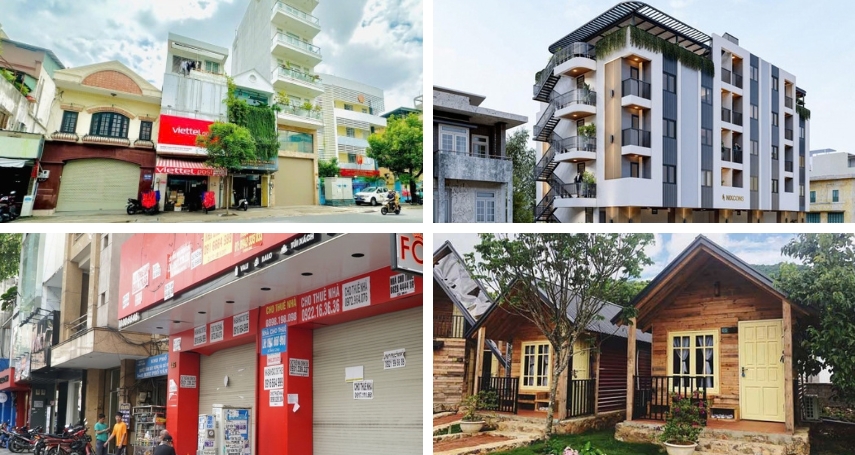
For beginners who are concerned about risk, residential segments such as apartments, entire townhouses for rent, or rental rooms should be prioritized. These property types generally have stable year-round rental demand, relatively straightforward legal procedures, and lower vacancy risks because housing is an essential need that is less affected by economic cycles.
Investors with experience who want to optimize returns per square meter can consider serviced apartments or mini-apartments rented by individual rooms, although these models require greater investment capital and more management effort.
For investors with substantial capital who are willing to accept higher risks in exchange for potentially higher returns, commercial premises or office space for rent can be considered due to their higher rental rates and longer lease terms. However, this segment is more sensitive to economic fluctuations when tenant businesses face financial difficulties.
For those looking to explore emerging segments, homestays or short-term rental apartments serving tourists can generate high returns during peak seasons. However, they also carry seasonal risks and depend heavily on locations near tourist attractions. Therefore, this model may be more suitable for investors who already own property in such areas rather than those making an entirely new investment.
Conclusion
Successful rental real estate investment requires careful consideration, from selecting the right location and identifying target tenants to calculating actual cash flow and managing vacancy risks and hidden costs throughout the operating process. If you are looking for a suitable commercial real estate investment solution or need to find rental premises, contact A-Connection for detailed consultation and support in optimizing your investment strategy.
References: Smartos, Rever
See also: