Tiếng Việt
 English
 简体中文
简体中文

Choosing an office that matches the size of your business is one of the most important decisions when a company starts operating, expands its workforce, or changes its operating model. An office that is too small can make the workplace crowded, while an excessively large space can increase unnecessary rental and operating costs.
In reality, choosing the right office space for your business size is not simply about determining how many square meters you need. Businesses also need to consider the number of employees, space layout, client reception needs, budget, location, office type, and development plans for the coming years.
If you are preparing to find an office, identifying your needs from the beginning will help streamline the search process, control your budget more effectively, and reduce the likelihood of having to relocate as the business grows.
Why Should You Choose an Office Based on Your Business Size?
Every business has different operational requirements and office space needs. Therefore, before searching for an office suitable for your business, you should clearly determine your current number of employees, space requirements, and development plans during the lease term. This helps avoid renting a space that is too small or paying for excess space that creates unnecessary costs.
This is also an important consideration alongside the location, infrastructure, legal, and cost criteria discussed in the article 6 Criteria for Renting Commercial Space as a Company Office.
1. Determine Your Business Size Before Renting an Office
Current Number of Employees
The number of employees is an important basis for estimating office space, but businesses should not make rental decisions based solely on their current workforce. It is also necessary to consider hiring plans and potential growth in the coming years.
For example, a company currently has 20 employees but plans to expand its team. Renting an office that only accommodates 20 people may quickly become restrictive. Conversely, if a business is still testing its business model and has no plans to increase its workforce, renting an excessively large space can create unnecessary costs and put pressure on the operating budget.
Business-Specific Requirements
Even businesses with the same number of employees may have very different office space requirements depending on their operations.
Companies that primarily work online may prioritize shared workspaces and require fewer meeting rooms, while businesses that frequently meet clients, organize training sessions, or require dedicated functional rooms may need more space.
Therefore, the experience of choosing the right office space for your business size is not simply about counting employees. Businesses also need to consider how the space will be used, operational requirements, and the need to arrange different functional areas.
Growth Plans During the Lease Term
Office leases often last for several years, so businesses should estimate their staffing and operational needs throughout the entire lease period.
If the company plans to hire more employees, expand departments, or increase its operational scale, it should prioritize an office with expansion potential or sufficient spare space. This can help minimize the need to relocate when the business grows while also reducing investment and renovation costs.

2. Calculate Office Space Based on the Number of Employees
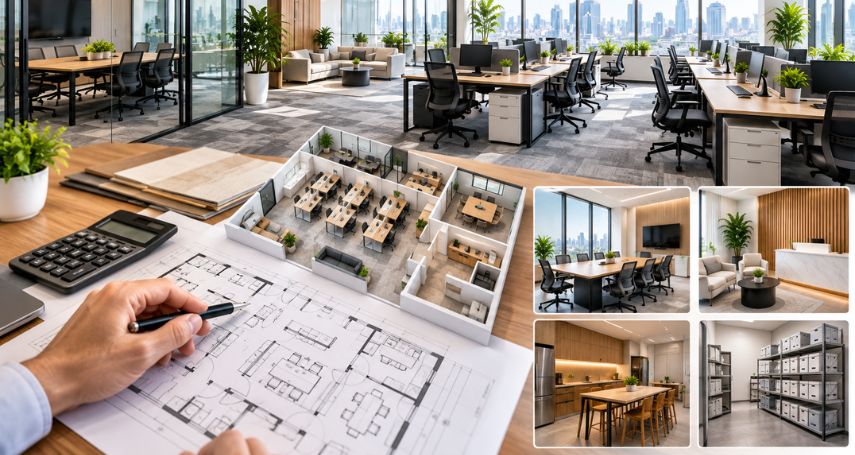
One of the most important factors when choosing an office is determining the actual space required. Businesses should not assume that the entire rented area will be used for workstations. In addition to employee work areas, space may be needed for meeting rooms, reception areas, pantries, document storage, equipment, and circulation.
Approximately 5–6 m² per person can be used as an initial reference point, but this is not a fixed standard for every business. For example, a company with 20 employees may estimate approximately 100–120 m² for the main working area, then allocate additional space for functional and supporting areas.
Businesses should also clearly distinguish between the leased area and the actual usable area before making a decision. The billable area may include sections that do not directly serve as workstations, so simply looking at the number of square meters stated in the lease does not fully reflect the office’s ability to meet operational needs.
Accurately assessing usable space will help businesses organize their workplace more efficiently and control rental costs more effectively.
Do Not Rent Exactly the Minimum Required Space
A common mistake when choosing an office is to calculate only the current number of workstations and rent exactly the required space. This approach may work for businesses with a stable workforce, but it can quickly become inconvenient for growing companies.
As the number of employees increases, the business may have to use meeting rooms or common areas to accommodate additional workstations.
Therefore, instead of relying solely on the current number of employees, businesses should consider potential workforce growth throughout the lease term. Having some additional space will make the office more flexible and reduce the need to relocate when the business expands.
3. Choose the Right Office Type for Your Business Size
Not every business needs a large traditional office. Choosing the right office type can help optimize initial investment costs and better match the company’s stage of development.
Small Businesses and Startups
For newly established businesses or companies with a small workforce, serviced offices, coworking spaces, or fully furnished offices are worth considering because they typically require lower initial investment and offer flexible workspace options.
However, if the business needs a private space, frequently meets clients, or wants to establish a professional brand image, a private office may be more suitable.
Medium-Sized Businesses
As the workforce grows, businesses also need more meeting rooms, reception areas, and functional spaces.
At this stage, companies should balance space, cost, and expansion potential. A private office in a professional building or a space designed according to specific business requirements can be a suitable choice while helping maintain a stable working environment and professional image.
Large Businesses
For businesses with a large workforce, office selection should take long-term operational requirements into account.
In addition to workspace, businesses should consider meeting rooms, functional rooms, reception areas, break areas, technical systems, elevators, parking facilities, and expansion potential to ensure that the office effectively meets actual operational needs.
4. Balance Your Budget When Choosing an Office
An office suitable for a business does not necessarily have to offer the lowest rental price. Instead, it should match the company’s budget and actual space requirements.
In addition to rent, businesses should consider management fees, electricity and water, internet, parking, cleaning, after-hours charges, and investments such as design, construction, and furniture if the rented space is unfinished.
Therefore, when comparing different options, businesses should evaluate the total cost required to make the office operational and maintain it throughout the lease term rather than focusing only on the rental price per square meter.

5. Prioritize Offices with Expansion Potential
One important consideration when renting an office is choosing a space that can accommodate future workforce growth.
Businesses should consider buildings or properties with adjacent space, flexible layouts, or policies that allow tenants to adjust the leased area.
Being able to expand at the existing location can help minimize disruption and reduce costs when the business grows.
6. Do Not Overlook Location and Accessibility
When choosing an office, businesses should consider accessibility for employees, clients, and business partners.
A convenient location not only reduces commuting time but can also support recruitment and contribute to a professional corporate image.
Businesses should also inspect the actual access routes, traffic conditions, parking, elevators, security, and surrounding amenities to ensure that the office meets everyday operational requirements.
7. Check the Infrastructure Before Deciding to Rent
An office may have the right amount of space, but if its infrastructure does not meet operational requirements, it may still be the wrong choice.
Businesses should inspect electrical systems, air conditioning, internet connectivity, elevators, fire prevention and firefighting systems, and other technical facilities, especially if they use significant amounts of technology equipment, servers, or specialized systems.
For offices located in commercial buildings, businesses should also learn about regulations regarding working hours, after-hours access, elevator usage, interior construction, and signage registration to ensure that the space can support actual operational needs.

8. Consider Your Brand Image When Choosing an Office
An office serves more than just functional working needs. It also contributes to the way a business presents its brand, particularly for companies that regularly meet clients and business partners.
Therefore, businesses should choose a space that matches their brand positioning and financial capacity rather than pursuing expensive offices simply for appearance.
Startups may prioritize modern, flexible, and cost-effective spaces, while businesses in finance, consulting, or professional services may require a more polished office with an appropriate reception area to create a professional impression.
9. Common Mistakes When Choosing an Office
Many businesses encounter problems after renting an office because the initial decision was based on only a few individual factors.
Focusing Only on Rent
A low rental price does not necessarily mean a low overall cost. If the office is far from central areas, has insufficient parking, requires extensive renovation, or involves numerous additional fees, the actual total cost may be higher than expected.
Renting Based on the Current Number of Employees
If the business is growing, renting an office that only accommodates the current workforce may cause the space to become overcrowded quickly.
Overlooking Renovation Costs
A property with an attractive rental price may require significant investment in furniture, electrical systems, air conditioning, or technical infrastructure, which can substantially increase the total budget.
Failing to Check Expansion Potential
If the business increases its workforce but the building no longer has adjacent space available, the company may have to relocate. This can create additional costs and disrupt business operations.
Viewing the Office Only Once
If possible, businesses should visit the office at different times to evaluate traffic, noise levels, elevator usage, and actual accessibility.
10. Office Selection Checklist for Different Business Sizes
Before making a decision, businesses can quickly review the following factors:
- Current number of employees and projected workforce during the lease term.
- Space required for work areas and functional rooms.
- Potential to expand the leased area as the business grows.
- Office type suitable for the company’s operating model.
- Total monthly rental and operating budget.
- Initial furniture and renovation investment costs.
- Location and employee accessibility.
- Parking availability and client reception capacity.
- Electrical, internet, air conditioning, and elevator systems.
- Fire prevention, firefighting, security, and other technical requirements.
- Building regulations regarding operating hours and construction.
- Key terms and conditions in the lease agreement.
If these factors are clearly defined before searching for a property, businesses can more easily eliminate unsuitable options and focus on offices that meet their actual requirements.
A-Connection Supports Businesses in Finding the Right Office
Finding an office that matches the size of a business requires more than comparing rental prices and floor areas. Businesses need to simultaneously evaluate space requirements, location, infrastructure, investment costs, expansion potential, and operating conditions.
A-Connection provides office leasing solutions with various office types and sizes, suitable for small businesses, startups, and large companies. Businesses can also explore A-Connection’s office leasing services to learn more about options that match their actual requirements.
In addition, A-Connection has a portfolio of commercial spaces and offices in various locations, giving businesses more options when searching for a suitable workplace.
If your business has not yet determined the appropriate office size or type, A-Connection can assist in analyzing your space requirements, budget, and operational direction to identify a more suitable solution.
Conclusion
The key to choosing an office that matches your business size is to determine your requirements before searching for a property rather than starting with rental prices.
Businesses should make their decision based on the number of employees, nature of work, required usable space, budget, location, and future growth plans.
A good office does not necessarily need to be large or located in an expensive area. Most importantly, it should meet current operational requirements, fit the company’s financial capacity, and provide enough flexibility to support the business throughout its development.
If you have an office leasing requirement for your business, clearly define your company size and space requirements before visiting potential properties. This is an important step toward saving time, controlling costs, and minimizing unnecessary changes during business operations.