Tiếng Việt
 English
 简体中文

Modern factory construction requires MEP (Mechanical, Electrical, and Plumbing) systems to meet production requirements and support long-term operations. However, choosing unsuitable solutions can increase investment costs, create technical risks, and affect construction progress. In this article, explore the key criteria for selecting MEP solutions for factories with A-Connection to identify an effective implementation plan.
1. Technical criteria for selecting MEP solutions for factories
MEP solutions directly affect a factory’s operational capabilities, safety, and production efficiency. Businesses should evaluate the following technical criteria to select systems that suit their scale and operational characteristics.
1.1. System capacity that meets production requirements
MEP capacity must be calculated based on the factory’s scale, the number of machines, and actual operational requirements. If the designed capacity is too low, the system may become overloaded when production lines operate simultaneously or production expands.
When evaluating capacity, businesses should consider:
- Total electrical load: Calculate the power consumption of machinery, lighting equipment, air conditioning, and auxiliary systems.
- HVAC requirements: Determine cooling and ventilation capacity based on the factory’s floor area, height, and generated heat.
- Water supply and drainage requirements: Ensure water flow meets production, cleaning, and domestic needs.
- Capacity reserve: Account for the possibility of adding machinery or expanding production lines in the future.
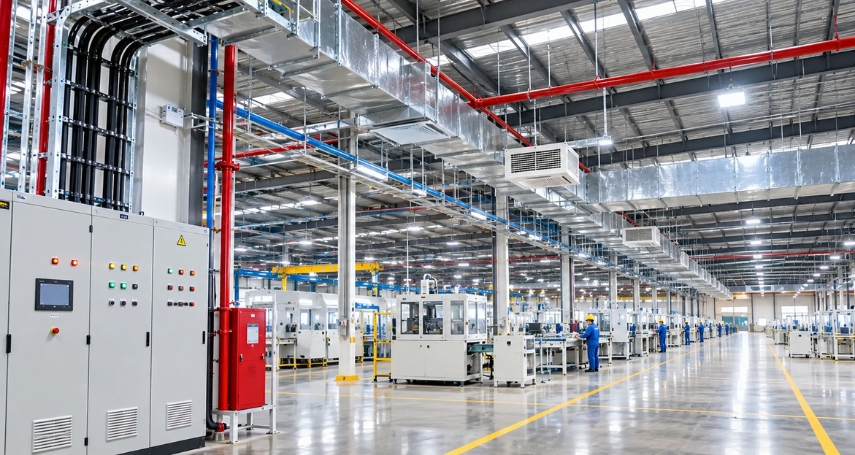
1.2. Integration of electrical, HVAC, and water supply and drainage systems
MEP components must be designed in an integrated manner to avoid technical conflicts and minimize additional construction costs. For example, water supply and drainage pipes should not interfere with electrical cable systems. Air duct locations must also be coordinated with the roof structure, beams, and lighting systems.
Businesses should check the following:
- MEP coordination drawings: Show the installation locations of pipes, cable trays, air ducts, and equipment.
- Technical spaces: Provide sufficient clearance for installation, inspection, and maintenance.
- System connectivity: Ensure that different systems can coordinate their operations and be controlled when necessary.
- Maintenance accessibility: Prioritize designs that allow convenient access to equipment, valves, electrical panels, and pipelines.
1.3. Suitability for specific production processes
Each manufacturing industry has its own technical requirements. Therefore, MEP solutions should be selected based on machinery, raw materials, and operational processes. Food processing factories may require temperature, humidity, and hygiene control, while mechanical engineering factories need to prioritize power supply for high-capacity machinery, ventilation, and dust extraction.
Several factors need to be identified:
- Production equipment: The capacity, voltage, operating mode, and connection requirements of each machine.
- Environmental conditions: Temperature, humidity, dust, chemical vapors, or generated exhaust gases.
- Process requirements: Compressed air, cooling water, process water, or a stable power supply.
- Functional zoning: MEP design suitable for production areas, warehouses, technical rooms, and auxiliary areas.
1.4. Compliance with technical and safety standards
MEP systems must comply with the technical regulations and standards applicable to each type of factory. Particular attention should be paid to electrical safety, fire prevention and firefighting, ventilation, and water supply and drainage to protect workers, machinery, and assets.
Businesses should also review design documents, technical specifications, equipment certificates, and acceptance records in accordance with applicable regulations. Each system must include risk control measures, incident response solutions, and provisions for safe operation throughout the production process.
1.5. Stable operation under continuous production conditions
For factories operating multiple shifts or continuously, MEP systems must maintain stable performance and minimize downtime. Businesses should prioritize solutions with equipment suited to the operating intensity, backup capacity, and incident response plans.
Several criteria should be evaluated:
- Equipment durability: Select equipment with specifications suitable for the required operating duration and intensity.
- Backup systems: Consider backup power sources or replacement equipment for critical components.
- Monitoring capabilities: Integrate sensors, alerts, and control systems to detect abnormalities.
- Maintenance convenience: Schedule regular maintenance without significantly affecting production activities.
- Incident response capabilities: Provide solutions to isolate individual areas or equipment to avoid disrupting the entire factory.
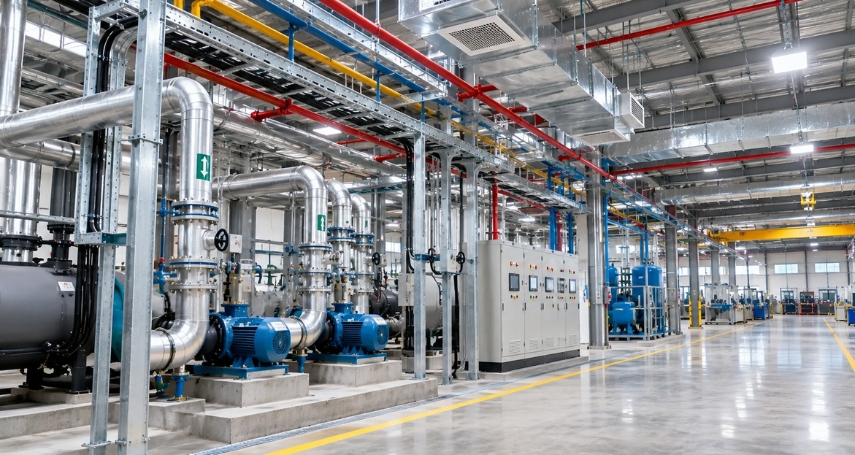
2. MEP systems to consider when designing a factory
MEP systems should be calculated and coordinated from the design stage to ensure stable, safe, and cost-effective factory operations. Below are five important system groups that businesses should pay attention to.
2.1. Electrical system standards
The electrical system must meet the power requirements of machinery, auxiliary equipment, and the entire factory’s operations. The design must also account for potential production expansion and ensure electrical safety.
- Electrical infrastructure planning: Arrange transformer substations, MSB and DB electrical panels, power distribution, lighting, and low-voltage systems.
- Load calculation: Determine the power consumption of each machine and production line to prevent overloading and voltage drops.
- Safety assurance: Install grounding, lightning protection, and overvoltage protection systems.
- Capacity reserve: Allow for approximately 15–20% additional load capacity to accommodate future expansion.
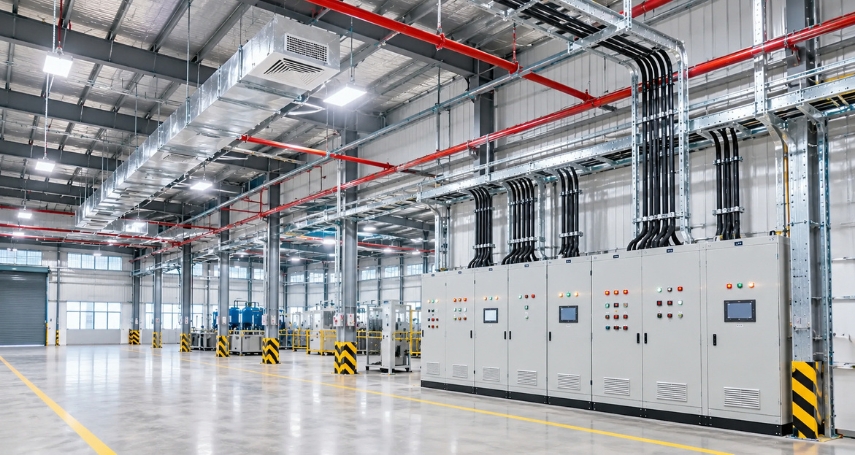
2.2. Water supply and drainage system standards
Water supply and drainage systems should be designed according to their intended uses to ensure sufficient flow and facilitate wastewater treatment. In addition, businesses should plan pipeline routes to minimize losses and simplify maintenance.
- Separate pipelines: Arrange separate lines for domestic water, production water, cooling water, and stormwater drainage.
- Wastewater treatment: Design an appropriate treatment system before discharging wastewater into the environment.
- Pipeline optimization: Shorten pipeline routes, minimize pressure losses, and arrange compressed air systems if required.
- Maintenance convenience: Arrange pipelines so they are easily accessible for inspection, repair, and replacement.
2.3. HVAC and ventilation standards
HVAC and ventilation systems help control temperature, humidity, and air quality inside factories. Equipment capacity must be calculated based on actual heat loads and the specific requirements of each manufacturing industry.
| Factors to control | Technical solutions |
|---|---|
| Temperature | Air conditioning, cooling fans, or chiller systems |
| Humidity | Appropriate humidity control equipment |
| Air quality | Fresh air supply and air filtration systems |
| Heat generated by machinery | Roof exhaust fans, side ventilation, or localized heat extraction |
| Energy consumption | Inverter-driven equipment and heat recovery solutions |
2.4. Fire prevention and firefighting (PCCC) system standards
Fire prevention and firefighting systems must be designed in coordination with the factory’s scale, functions, and risk levels. All components must meet legal requirements while ensuring timely incident detection and response.
- Fire protection equipment layout: Integrate fire alarm systems, sprinklers, fire hydrants, pump stations, and emergency lighting.
- Regulatory compliance: Apply fire prevention and firefighting regulations and standards appropriate to the project.
- Technical system coordination: Avoid conflicts between firefighting pipes, cable trays, and air ducts.
- Smoke control and emergency evacuation: Arrange suitable smoke extraction solutions, doors, and emergency exits.
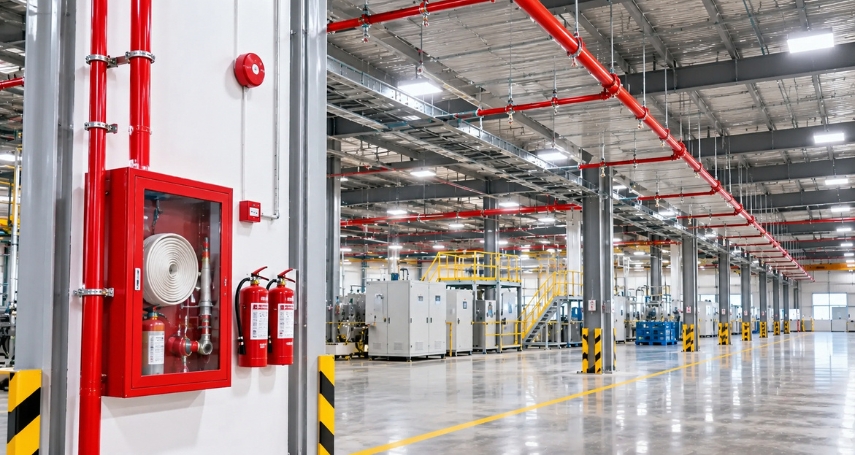
2.5. Standards for system integration, safety, and operational capabilities
MEP systems must be closely coordinated with the factory’s structural and architectural components to minimize conflicts during construction. The design must also ensure monitoring, maintenance, and expansion capabilities throughout the operational process.
- Application of 3D BIM: Detect conflicts between pipelines, cable trays, floor beams, and structural components before construction.
- Technical space planning: Reserve sufficient space for equipment installation, operation, and maintenance.
- BMS integration: Connect electromechanical systems to monitor operating parameters and issue incident alerts.
- Zoning design: Separate technical networks by area to facilitate production line expansion without affecting existing operations.
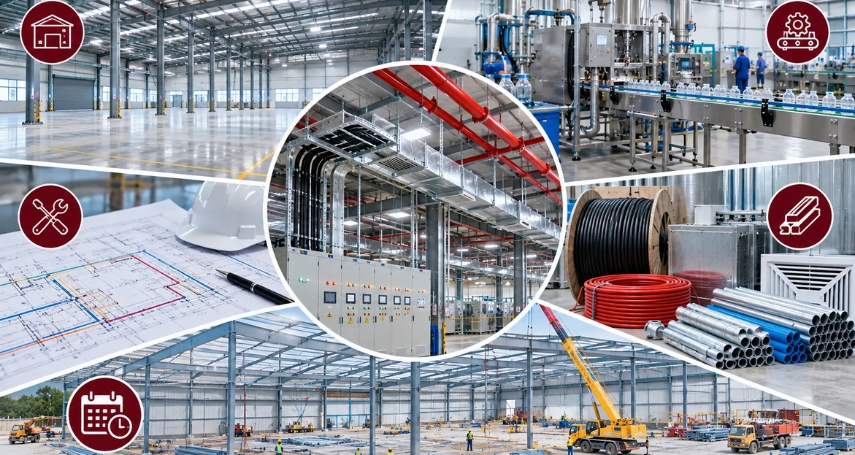
3. Factors affecting factory MEP system investment costs
MEP system investment costs depend on the factory’s scale, production characteristics, and technical requirements of each project. Clearly identifying the following factors helps businesses estimate their budgets and select suitable solutions.
- Factory scale and floor area: Large factories with multiple functional areas generally require higher-capacity electrical, HVAC, and water supply and drainage systems, resulting in higher investment costs.
- Manufacturing industry characteristics: Industries such as food processing, pharmaceuticals, and electronics often have strict requirements for temperature, humidity, cleanliness, and environmental treatment. Therefore, MEP costs may be higher than those of conventional manufacturing factories.
- Technical system complexity: Projects involving multiple high-capacity machines, automated production lines, or specialized control systems require more complex MEP design and installation.
- Equipment and material quality: Imported equipment, premium brands, or materials with high durability and performance generally have higher initial costs. However, businesses should also consider service life, energy consumption, and maintenance costs.
- Construction schedule and site conditions: Tight deadlines, limited construction space, or the need to renovate existing systems may increase labor, transportation, and construction management costs.
4. Risks of choosing unsuitable MEP solutions
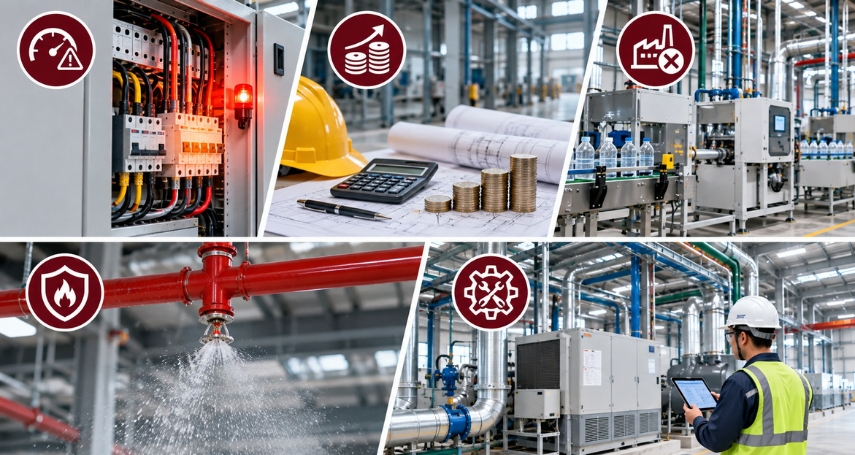
Choosing MEP solutions that do not match a factory’s scale and production characteristics can directly affect its operations. The following risks not only increase costs but also affect construction progress and long-term operational efficiency.
- System overload and inefficient operation: Electrical, HVAC, or water supply and drainage capacities that fail to meet actual requirements may cause overloading, voltage drops, inadequate cooling, and production interruptions.
- Additional construction costs: Poor coordination between MEP systems and factory structures can lead to conflicts involving pipelines, cable trays, and air ducts, requiring adjustments or rework.
- Failure to meet production requirements: Unsuitable ventilation, temperature and humidity control, or power supply systems may affect product quality and production line efficiency.
- Increased safety risks: Electrical, fire protection, and environmental treatment designs that fail to meet technical requirements may increase the risk of fires, explosions, equipment failures, and harm to workers.
- Difficulties in system expansion and maintenance: Insufficient backup capacity, technical space, or zoning plans can make future machinery additions, repairs, and system upgrades more costly.
5. Professional factory MEP design and construction solutions with A-Connection
Choosing a qualified MEP design and construction contractor helps businesses control project quality, optimize budgets, and minimize implementation risks. With a focus on providing electromechanical solutions for factories, A-Connection supports businesses throughout the entire process, from system design and construction to maintenance.
The benefits of choosing A-Connection for MEP construction include:
- Superior quality: Use genuine equipment, ensure precise electromechanical installation, and meet applicable technical standards.
- Optimized solutions: Control investment costs while improving operational efficiency and achieving long-term budget savings.
- Professional team: Experienced engineers and workers with expertise in MEP system design and construction.
- Comprehensive services: Provide services ranging from design and construction to maintenance and servicing, helping systems operate safely and reliably.
Conclusion
Choosing suitable MEP solutions helps factories operate reliably, ensure safety, and optimize long-term investment costs. Businesses should carefully consider technical criteria, production characteristics, and construction capabilities to achieve the best operational results. Contact A-Connection at 0968 68 8081 for consultation and a detailed quotation for your company’s MEP construction project.
Read more: