Tiếng Việt
 English
 简体中文

The increasingly competitive office market is making it difficult for many property owners to attract tenants and maintain stable occupancy rates. Prolonged vacant space not only affects revenue but also reduces the efficiency of building operations. This article examines the factors affecting office building occupancy rates, providing property owners with a basis for adjusting their leasing strategies accordingly.
1. Five factors affecting office building occupancy rates
The occupancy rate reflects an office building’s leasing performance and competitiveness. This indicator is influenced by various factors, including location, rental rates, building quality, amenities, and property management capabilities.
1.1 Location and transportation connectivity
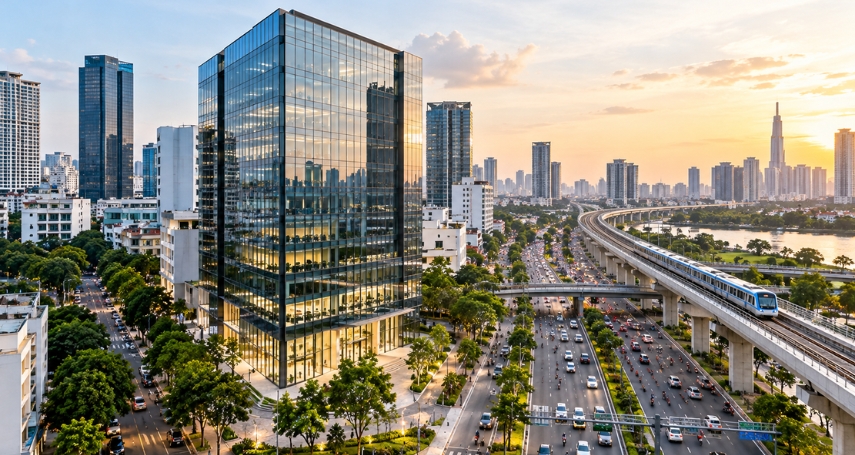
Location directly influences office leasing decisions because it affects commuting time, accessibility for clients, and convenience for employees. Buildings near business districts, major roads, metro stations, or public transportation routes generally have an advantage in attracting businesses. However, a prime location must also offer practical accessibility, without frequent traffic congestion or insufficient parking spaces.
Several location criteria can affect occupancy rates, including:
- Transportation connectivity: Proximity to major roads, public transportation, metro stations, or bus routes.
- Accessibility: Convenient entrances, easy-to-find addresses, and minimal prolonged traffic congestion during rush hours.
- Business district: Proximity to banks, government offices, shopping malls, and business support services.
- Parking facilities: Sufficient parking spaces for employees, clients, and business partners, including motorcycles and cars.
1.2 Rental rates and total office occupancy costs
Rental rates are a major factor influencing tenants’ decisions to choose a property and maintain their lease agreements. However, businesses do not simply compare the rental price per square meter; they also consider the total costs incurred throughout the occupancy period. A building with competitive rental rates may still be less attractive than other options if it has high service charges, parking fees, and operating costs.
Property owners should establish pricing policies that match their target tenant segments while ensuring transparency regarding related expenses, such as:
- Base rent: The rental rate calculated based on the leased area and contract term.
- Service charges: Costs for cleaning common areas, security, building operations, and system maintenance.
- Parking fees: Charges for motorcycle and car parking for employees and visitors.
- Interior fit-out costs: The budget for designing, constructing, and installing electrical systems, network infrastructure, and air conditioning inside the office.
- Lease terms: Security deposits, rent-free fit-out periods, periodic rental increases, and other additional charges.
1.3 Building quality and classification
Building quality and classification standards influence the types of tenants a property can attract. Businesses typically consider factors such as floor plan design, technical systems, finishing quality, floor area, and the building’s ability to meet their operational requirements. A well-invested building has a competitive advantage when tenants compare available options within the same location and price segment.
Building quality can be assessed based on the following criteria:
| Criteria | Factors to evaluate |
|---|---|
| Design and floor plan | Flexible floor areas, minimal obstructive columns, and layouts that are easy to divide into work zones and furnish. |
| Technical systems | Stable operation of air conditioning, electrical systems, lighting, internet, elevators, and fire protection systems. |
| Finishing quality | Well-maintained floors, ceilings, walls, facades, and common areas with minimal deterioration. |
| Building standards | Compliance with safety, environmental, and energy-efficiency requirements, as well as green certifications where applicable. |
One important point to note is that a building’s Grade A, B, or C classification does not automatically determine its occupancy rate. The building’s quality must be appropriate for its rental price and the needs of its target tenant segment.
For example, a Grade B project with a flexible floor plan, reasonable rental rates, and stable operations may attract more businesses than a Grade A building with rents exceeding tenants’ budgets or an inconvenient location. In fact, Savills’ office market report for Ho Chi Minh City recorded high occupancy rates in the non-CBD Grade A segment, supported by a combination of building quality and competitive rental rates.
1.4 On-site amenities and tenant services
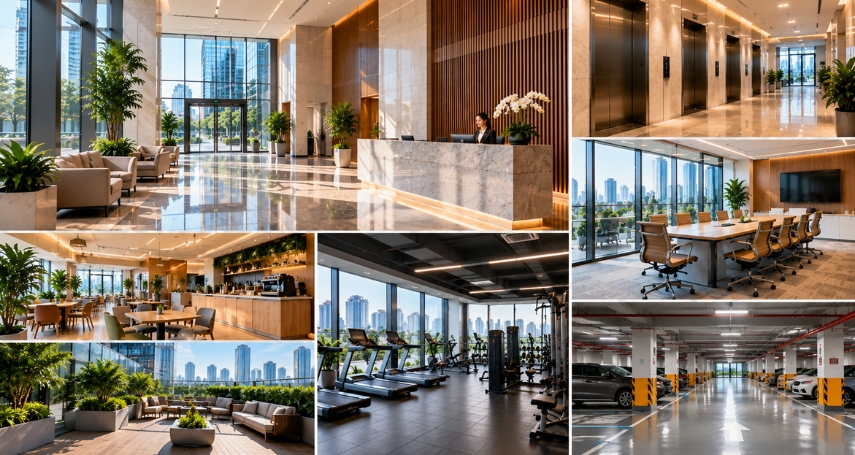
On-site amenities enhance the working experience and give buildings an additional competitive advantage. Practical facilities such as dining areas, reception lobbies, shared meeting rooms, convenience stores, and parking facilities can help businesses save time while making the workplace more convenient for employees.
Depending on the building’s scale and market segment, property owners can invest in amenities such as:
- Work-related amenities: Reception lobbies, shared meeting rooms, waiting areas, and flexible workspaces.
- Lifestyle amenities: Canteens, cafés, convenience stores, and relaxation areas.
- Transportation amenities: Parking facilities, elevators, passenger pick-up and drop-off areas, and convenient access routes.
- Employee support amenities: Green spaces, relaxation areas, fitness rooms, or communal spaces.
- Support services: Reception, security, cleaning, mail handling, and technical support.
There is no need to invest in an excessive number of premium amenities to make a building more attractive. Property owners should prioritize services that tenants use regularly and that suit the characteristics of the surrounding area. According to CBRE, on-site dining options and access to nearby amenities are among the factors businesses consider when choosing an office location.
1.5 Developer reputation and property management capabilities
The developer’s reputation and the quality of property management influence businesses’ confidence when making long-term leasing decisions. A building may have an attractive design, but frequent elevator, air conditioning, or utility failures, as well as slow responses to service requests, can discourage tenants from renewing their leases. In contrast, professional management helps maintain building quality and ensures a consistent experience throughout the occupancy period.
Businesses typically assess property management capabilities through several specific aspects:
- Developer reputation: Project development track record, financial capacity, and ability to fulfill commitments to tenants.
- Transparent lease management: Clearly defined lease terms, service charges, rental increase policies, and responsibilities of each party.
- Maintenance and incident handling: Established procedures for receiving service requests, response times, and regular system maintenance schedules.
- Security and safety: Access control, surveillance of common areas, and maintenance of fire protection systems.
- Tenant care: Assistance with administrative procedures, answering questions, and receiving feedback throughout the occupancy period.
In particular, the property management team’s responsiveness can directly affect tenants’ lease renewal decisions. When incidents are resolved promptly, additional costs are communicated transparently, and tenants’ rights are protected, businesses have more reasons to remain in the building.
2. How office supply affects building occupancy rates
A rapid increase in new office supply creates competitive pressure, especially in areas where multiple projects in the same market segment are concentrated. With more options in terms of location, floor area, and rental rates, tenants can compare properties more easily, forcing existing buildings to adjust their policies to retain occupants. Conversely, areas with limited supply and stable demand often have an advantage in maintaining occupancy levels.
Office supply also varies across different locations. According to Savills, in Q2 2025, Ho Chi Minh City had approximately 2.9 million m² of office space, with an occupancy rate of 88%, while Hanoi had 2.28 million m² and an occupancy rate of 83%. This indicates that occupancy rates also depend on market characteristics and how well available supply matches actual leasing demand.
In addition, new projects with higher quality, modern designs, and flexible leasing policies may attract tenants away from older buildings. Therefore, property owners should monitor upcoming office supply and assess competitors in the same area, market segment, and price range to adjust their leasing strategies accordingly.

3. Why office buildings in prime locations may still have low occupancy rates
A convenient location does not necessarily guarantee a high occupancy rate. If rental rates exceed tenants’ budgets, along with additional service charges, parking fees, and interior fit-out costs, businesses may prefer nearby buildings with more reasonable total occupancy costs.
In addition, unsuitable building quality and floor plan design can make tenants hesitant. Floor areas that are difficult to subdivide, excessive structural columns, insufficient parking spaces, or deteriorating technical systems can increase renovation costs and limit the building’s leasing potential.
Furthermore, inflexible leasing policies, ineffective marketing, or poor property management services can make it difficult for a building to attract and retain tenants. Property owners should identify the reasons behind vacant spaces and gather feedback from businesses to adjust rental rates, lease policies, and operational quality accordingly.
4. Key indicators property owners should monitor beyond building occupancy rates
In addition to occupancy rates, property owners should pay attention to indicators that reflect tenant retention, leasing performance, and operating costs. The following four indicators are particularly important for assessing a building’s business performance:
- Tenant retention rate: Indicates the proportion of tenants who renew their lease agreements upon expiration. A low rate may signal issues with rental prices, service quality, or the occupancy experience.
- Average rental rate: Reflects the actual rental price per square meter. Property owners can use this indicator to assess competitiveness and determine whether current rental rates are in line with the market.
- Average leasing time: Measures the period from when a space is listed on the market until a lease agreement is signed. If this period becomes prolonged, property owners should review rental rates, promotional policies, or the quality of the space.
- Operating cost per square meter: Includes expenses for maintenance, cleaning, security, utilities, and building management. Monitoring this indicator helps control budgets, minimize waste, and improve operational efficiency.
In addition to these four indicators, property owners can also monitor the on-time rent collection rate to manage cash flow and outstanding receivables. This is essential data for assessing tenants’ payment capacity, particularly in buildings with many businesses on long-term leases.
5. A-Connection: Effective office leasing solutions
To improve occupancy rates, property owners need to reach the right groups of potential tenants. A-Connection provides consulting and business connection solutions, helping companies find office spaces that match their preferred locations, floor areas, and budgets. This supports businesses in finding suitable workspaces while helping building owners optimize the efficiency of their leasable areas.
Conclusion
Office building occupancy rates depend on various factors, including location, rental rates, building quality, amenities, and property management capabilities. Property owners should monitor operational indicators to make timely adjustments to their leasing strategies. Contact A-Connection for office leasing consultation, connections with potential tenants, and solutions to optimize the efficiency of your leasable space.
See also: